
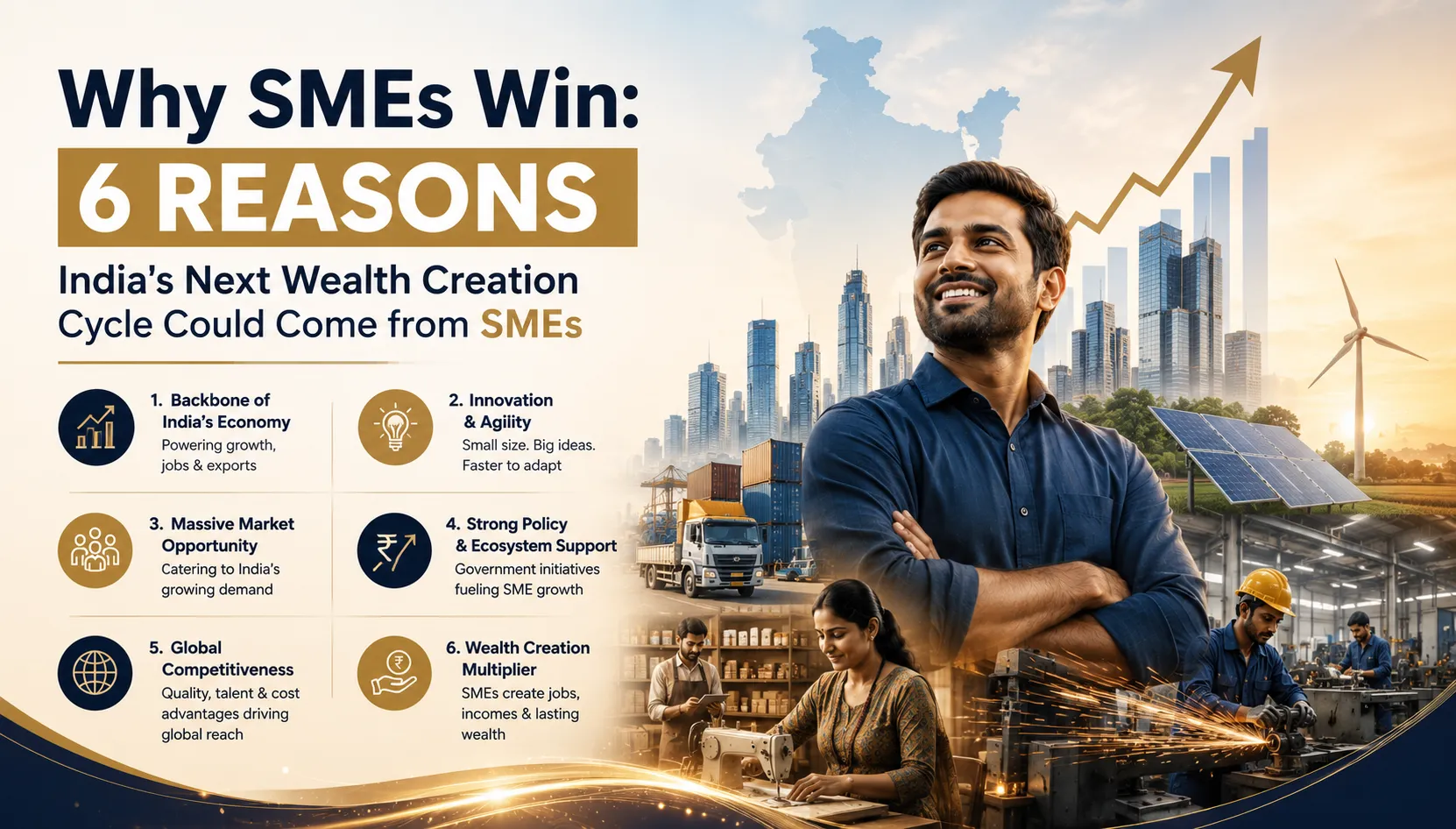
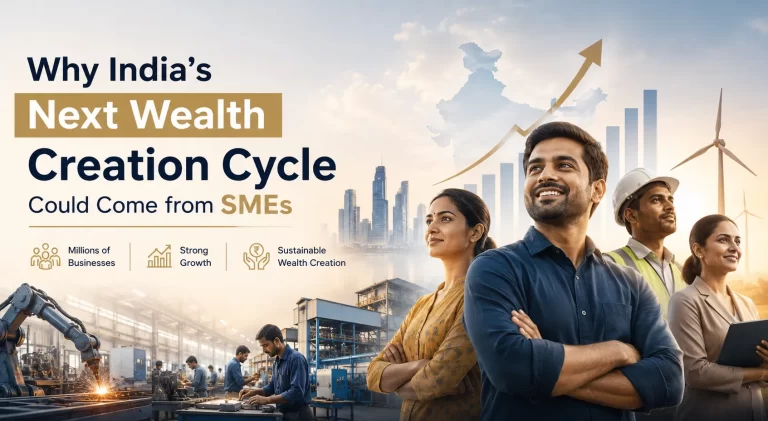
Why SMEs Win: 6 Reasons India’s Next Wealth Creation Cycle Could Come from SMEs

Why SMEs Win: 6 Reasons India's Next Wealth Creation Cycle Could Come from Small & Medium Enterprises

India has entered a new phase of economic growth. Manufacturing is expanding, digital infrastructure is strengthening, formalisation is accelerating, and capital markets are becoming increasingly accessible to growing businesses.

Against this backdrop, Small and Medium Enterprises (SMEs) are emerging as an important part of India’s long-term growth story.

While not every SME will become a market leader, many of India’s most successful listed companies started as relatively small businesses with capable founders, niche expertise and disciplined execution.

For long-term investors, the opportunity lies in understanding the structural characteristics that allow select SMEs to scale over time.

In Brief: Why Do SMEs Win?

SMEs often outperform during periods of economic expansion because they combine founder-led decision-making, operational agility, access to growing domestic demand and increasing institutional capital. Government reforms, improving governance standards and deeper capital markets have further strengthened the ecosystem, creating favourable conditions for high-quality businesses to scale.

Why Are SMEs Becoming Attractive Investment Opportunities?

Several long-term trends are reshaping India’s SME landscape.

  • Increasing formalisation of businesses
  • Growing domestic manufacturing
  • Expansion of digital infrastructure
  • Improved access to equity and debt capital
  • Government initiatives supporting entrepreneurship
  • Rising participation from institutional investors
  • Greater focus on governance and compliance

Together, these trends create an environment where well-managed SMEs can grow faster than they could in previous decades.

“While it’s tempting to pull back, we believe that companies that double down on growth will not only rebound faster but will also emerge stronger as a result. “

1. Founder-Led Businesses Create Better Long-Term Alignment

One of the defining characteristics of many successful SMEs is founder leadership.

Unlike larger corporations where ownership and management are often separated, SME founders typically remain significant shareholders even after listing.

This creates strong alignment between management decisions and shareholder interests.

Founder-led businesses frequently demonstrate:

  • Long-term strategic thinking
  • Faster decision-making
  • Industry-specific expertise
  • Disciplined capital allocation
  • Greater accountability

For investors, promoter ownership often signals confidence in the long-term future of the business, although governance quality and execution remain equally important.

2. Valuation Inefficiencies Can Create Long-Term Opportunities

Compared with large-cap companies, many SMEs receive relatively limited institutional research coverage.

As a result, strong businesses may remain undervalued during the early stages of their growth journey.

As companies improve earnings, governance and market visibility, institutional participation often increases, leading to a gradual re-rating of valuations.

Rather than chasing already mature businesses, long-term investors often seek companies where business fundamentals are improving ahead of broader market recognition.

3. Government Policies Continue to Strengthen the SME Ecosystem

India’s policy environment has significantly improved the operating landscape for SMEs.

Important initiatives include:

  • Goods and Services Tax (GST)
  • Production Linked Incentive (PLI) Schemes
  • Udyam Registration
  • Digital Public Infrastructure
  • TReDS invoice financing platform
  • Credit Guarantee Schemes for MSMEs

These reforms have encouraged formalisation, improved financing access and strengthened competitiveness across industries.

Key Facts About India's MSME Sector

Metric

Latest Estimate

Contribution to India’s GDP

~30%

Share of Manufacturing Output     

~36%

Share of Exports

~46%

Employment Supported

20+ crore people

These figures demonstrate that SMEs are not a niche segment—they are one of the largest contributors to India’s economic growth.

4. SMEs Often Innovate Faster Than Larger Organisations

Innovation is not limited to technology startups.

Across manufacturing, engineering, pharmaceuticals, industrial automation and software, SMEs frequently improve products, processes and customer solutions at a rapid pace.

Smaller organisational structures allow management teams to respond more quickly to market feedback, changing customer requirements and technological advancements.

Research by NASSCOM highlights the growing adoption of digital technologies among Indian SMEs, improving productivity and competitiveness across sectors.

Innovation does not always mean creating something entirely new—it often means continuously improving what already exists.

6. Capital Efficiency Drives Long-Term Wealth Creation

Revenue growth alone does not create shareholder wealth.

Sustainable value creation depends on how effectively a business allocates capital.

Many successful SMEs operate focused business models that require disciplined investment while generating attractive returns on invested capital.

Businesses capable of reinvesting profits at high rates of return often create significant long-term compounding for shareholders.

For investors, capital efficiency can be just as important as revenue growth.

Why India’s SME Opportunity Is Structural, Not Cyclical

India’s SME ecosystem is benefiting from multiple structural tailwinds:

  • A growing domestic economy
  • Rising manufacturing activity
  • Digital transformation
  • Expanding formalisation
  • Better financing options
  • Strong entrepreneurial culture
  • Increasing participation from capital markets

These changes are not short-term market events.

They represent long-term shifts in the way Indian businesses are created, funded and scaled.

As a result, SMEs are becoming increasingly important contributors to India’s future economic growth.

Frequently Asked Questions

SMEs can offer higher growth potential because they operate from a smaller base, remain founder-led and often benefit from expanding industries. Successful businesses may also experience valuation re-rating as institutional participation increases.

Generally, yes. SMEs may have lower liquidity, shorter operating histories and greater earnings volatility. Careful evaluation of governance, financial performance, industry dynamics and management quality is therefore essential.

Initiatives such as GST, PLI schemes, digital public infrastructure and easier financing have strengthened the operating environment for SMEs by improving formalisation, competitiveness and access to capital.

Many of today’s established listed companies began as small businesses. While not every SME achieves significant scale, businesses with strong management, sound governance and scalable business models can create substantial long-term value.

Final Thoughts

India’s next generation of market leaders may not necessarily emerge from businesses that are already well known.

Many are likely to be companies that are currently strengthening governance, expanding capacity, building specialised capabilities and steadily increasing their market presence.

For investors, understanding these structural trends is often more valuable than predicting short-term market movements.

As India’s economy continues to evolve, high-quality SMEs could play an increasingly significant role in the country’s next wealth creation cycle.

Sources

  1. Ministry of Micro, Small & Medium Enterprises (Government of India) – https://www.msme.gov.in
  2. Press Information Bureau (Government of India): MSME contribution to GDP, manufacturing, exports and employment.
  3. Economic Survey of India 2025–26, Ministry of Finance.
  4. SIDBI Annual Report 2023–24.
  5. NASSCOM SME Digital & Innovation Reports.
  6. Reserve Bank of India – Report on Currency and Finance.
  7. World Bank – India Development Update.
Tags:

What do you think?

Leave a Reply

Your email address will not be published. Required fields are marked *

Why SMEs Win: 6 Reasons India’s Next Wealth Creation Cycle Could Come from SMEs

Why SMEs Win: 6 Reasons India's Next Wealth Creation Cycle Could Come from Small & Medium Enterprises

India has entered a new phase of economic growth. Manufacturing is expanding, digital infrastructure is strengthening, formalisation is accelerating, and capital markets are becoming increasingly accessible to growing businesses.

Against this backdrop, Small and Medium Enterprises (SMEs) are emerging as an important part of India’s long-term growth story.

While not every SME will become a market leader, many of India’s most successful listed companies started as relatively small businesses with capable founders, niche expertise and disciplined execution.

For long-term investors, the opportunity lies in understanding the structural characteristics that allow select SMEs to scale over time.

In Brief: Why Do SMEs Win?

SMEs often outperform during periods of economic expansion because they combine founder-led decision-making, operational agility, access to growing domestic demand and increasing institutional capital. Government reforms, improving governance standards and deeper capital markets have further strengthened the ecosystem, creating favourable conditions for high-quality businesses to scale.

Why Are SMEs Becoming Attractive Investment Opportunities?

Several long-term trends are reshaping India’s SME landscape.

  • Increasing formalisation of businesses
  • Growing domestic manufacturing
  • Expansion of digital infrastructure
  • Improved access to equity and debt capital
  • Government initiatives supporting entrepreneurship
  • Rising participation from institutional investors
  • Greater focus on governance and compliance

Together, these trends create an environment where well-managed SMEs can grow faster than they could in previous decades.

“While it’s tempting to pull back, we believe that companies that double down on growth will not only rebound faster but will also emerge stronger as a result. “

1. Founder-Led Businesses Create Better Long-Term Alignment

One of the defining characteristics of many successful SMEs is founder leadership.

Unlike larger corporations where ownership and management are often separated, SME founders typically remain significant shareholders even after listing.

This creates strong alignment between management decisions and shareholder interests.

Founder-led businesses frequently demonstrate:

  • Long-term strategic thinking
  • Faster decision-making
  • Industry-specific expertise
  • Disciplined capital allocation
  • Greater accountability

For investors, promoter ownership often signals confidence in the long-term future of the business, although governance quality and execution remain equally important.

2. Valuation Inefficiencies Can Create Long-Term Opportunities

Compared with large-cap companies, many SMEs receive relatively limited institutional research coverage.

As a result, strong businesses may remain undervalued during the early stages of their growth journey.

As companies improve earnings, governance and market visibility, institutional participation often increases, leading to a gradual re-rating of valuations.

Rather than chasing already mature businesses, long-term investors often seek companies where business fundamentals are improving ahead of broader market recognition.

3. Government Policies Continue to Strengthen the SME Ecosystem

India’s policy environment has significantly improved the operating landscape for SMEs.

Important initiatives include:

  • Goods and Services Tax (GST)
  • Production Linked Incentive (PLI) Schemes
  • Udyam Registration
  • Digital Public Infrastructure
  • TReDS invoice financing platform
  • Credit Guarantee Schemes for MSMEs

These reforms have encouraged formalisation, improved financing access and strengthened competitiveness across industries.

Key Facts About India's MSME Sector

Metric

Latest Estimate

Contribution to India’s GDP

~30%

Share of Manufacturing Output     

~36%

Share of Exports

~46%

Employment Supported

20+ crore people

These figures demonstrate that SMEs are not a niche segment—they are one of the largest contributors to India’s economic growth.

4. SMEs Often Innovate Faster Than Larger Organisations

Innovation is not limited to technology startups.

Across manufacturing, engineering, pharmaceuticals, industrial automation and software, SMEs frequently improve products, processes and customer solutions at a rapid pace.

Smaller organisational structures allow management teams to respond more quickly to market feedback, changing customer requirements and technological advancements.

Research by NASSCOM highlights the growing adoption of digital technologies among Indian SMEs, improving productivity and competitiveness across sectors.

Innovation does not always mean creating something entirely new—it often means continuously improving what already exists.

6. Capital Efficiency Drives Long-Term Wealth Creation

Revenue growth alone does not create shareholder wealth.

Sustainable value creation depends on how effectively a business allocates capital.

Many successful SMEs operate focused business models that require disciplined investment while generating attractive returns on invested capital.

Businesses capable of reinvesting profits at high rates of return often create significant long-term compounding for shareholders.

For investors, capital efficiency can be just as important as revenue growth.

Why India’s SME Opportunity Is Structural, Not Cyclical

India’s SME ecosystem is benefiting from multiple structural tailwinds:

  • A growing domestic economy
  • Rising manufacturing activity
  • Digital transformation
  • Expanding formalisation
  • Better financing options
  • Strong entrepreneurial culture
  • Increasing participation from capital markets

These changes are not short-term market events.

They represent long-term shifts in the way Indian businesses are created, funded and scaled.

As a result, SMEs are becoming increasingly important contributors to India’s future economic growth.

Frequently Asked Questions

SMEs can offer higher growth potential because they operate from a smaller base, remain founder-led and often benefit from expanding industries. Successful businesses may also experience valuation re-rating as institutional participation increases.

Generally, yes. SMEs may have lower liquidity, shorter operating histories and greater earnings volatility. Careful evaluation of governance, financial performance, industry dynamics and management quality is therefore essential.

Initiatives such as GST, PLI schemes, digital public infrastructure and easier financing have strengthened the operating environment for SMEs by improving formalisation, competitiveness and access to capital.

Many of today’s established listed companies began as small businesses. While not every SME achieves significant scale, businesses with strong management, sound governance and scalable business models can create substantial long-term value.

Final Thoughts

India’s next generation of market leaders may not necessarily emerge from businesses that are already well known.

Many are likely to be companies that are currently strengthening governance, expanding capacity, building specialised capabilities and steadily increasing their market presence.

For investors, understanding these structural trends is often more valuable than predicting short-term market movements.

As India’s economy continues to evolve, high-quality SMEs could play an increasingly significant role in the country’s next wealth creation cycle.

Sources

  1. Ministry of Micro, Small & Medium Enterprises (Government of India) – https://www.msme.gov.in
  2. Press Information Bureau (Government of India): MSME contribution to GDP, manufacturing, exports and employment.
  3. Economic Survey of India 2025–26, Ministry of Finance.
  4. SIDBI Annual Report 2023–24.
  5. NASSCOM SME Digital & Innovation Reports.
  6. Reserve Bank of India – Report on Currency and Finance.
  7. World Bank – India Development Update.
14%
portion of total synergy savings derived from IT consolidation

Why SMEs Win: 6 Reasons India’s Next Wealth Creation Cycle Could Come from SMEs

Why India’s Next Wealth Creation Cycle Could Come from SMEs-bn-img

Why SMEs Win: 6 Reasons India's Next Wealth Creation Cycle Could Come from Small & Medium Enterprises

India has entered a new phase of economic growth. Manufacturing is expanding, digital infrastructure is strengthening, formalisation is accelerating, and capital markets are becoming increasingly accessible to growing businesses.

Against this backdrop, Small and Medium Enterprises (SMEs) are emerging as an important part of India’s long-term growth story.

While not every SME will become a market leader, many of India’s most successful listed companies started as relatively small businesses with capable founders, niche expertise and disciplined execution.

For long-term investors, the opportunity lies in understanding the structural characteristics that allow select SMEs to scale over time.

In Brief: Why Do SMEs Win?

SMEs often outperform during periods of economic expansion because they combine founder-led decision-making, operational agility, access to growing domestic demand and increasing institutional capital. Government reforms, improving governance standards and deeper capital markets have further strengthened the ecosystem, creating favourable conditions for high-quality businesses to scale.

Why Are SMEs Becoming Attractive Investment Opportunities?

Several long-term trends are reshaping India’s SME landscape.

  • Increasing formalisation of businesses
  • Growing domestic manufacturing
  • Expansion of digital infrastructure
  • Improved access to equity and debt capital
  • Government initiatives supporting entrepreneurship
  • Rising participation from institutional investors
  • Greater focus on governance and compliance

Together, these trends create an environment where well-managed SMEs can grow faster than they could in previous decades.

“While it’s tempting to pull back, we believe that companies that double down on growth will not only rebound faster but will also emerge stronger as a result. “

1. Founder-Led Businesses Create Better Long-Term Alignment

One of the defining characteristics of many successful SMEs is founder leadership.

Unlike larger corporations where ownership and management are often separated, SME founders typically remain significant shareholders even after listing.

This creates strong alignment between management decisions and shareholder interests.

Founder-led businesses frequently demonstrate:

  • Long-term strategic thinking
  • Faster decision-making
  • Industry-specific expertise
  • Disciplined capital allocation
  • Greater accountability

For investors, promoter ownership often signals confidence in the long-term future of the business, although governance quality and execution remain equally important.

2. Valuation Inefficiencies Can Create Long-Term Opportunities

Compared with large-cap companies, many SMEs receive relatively limited institutional research coverage.

As a result, strong businesses may remain undervalued during the early stages of their growth journey.

As companies improve earnings, governance and market visibility, institutional participation often increases, leading to a gradual re-rating of valuations.

Rather than chasing already mature businesses, long-term investors often seek companies where business fundamentals are improving ahead of broader market recognition.

3. Government Policies Continue to Strengthen the SME Ecosystem

India’s policy environment has significantly improved the operating landscape for SMEs.

Important initiatives include:

  • Goods and Services Tax (GST)
  • Production Linked Incentive (PLI) Schemes
  • Udyam Registration
  • Digital Public Infrastructure
  • TReDS invoice financing platform
  • Credit Guarantee Schemes for MSMEs

These reforms have encouraged formalisation, improved financing access and strengthened competitiveness across industries.

Key Facts About India's MSME Sector

Metric

Latest Estimate

Contribution to India’s GDP

~30%

Share of Manufacturing Output     

~36%

Share of Exports

~46%

Employment Supported

20+ crore people

These figures demonstrate that SMEs are not a niche segment—they are one of the largest contributors to India’s economic growth.

4. SMEs Often Innovate Faster Than Larger Organisations

Innovation is not limited to technology startups.

Across manufacturing, engineering, pharmaceuticals, industrial automation and software, SMEs frequently improve products, processes and customer solutions at a rapid pace.

Smaller organisational structures allow management teams to respond more quickly to market feedback, changing customer requirements and technological advancements.

Research by NASSCOM highlights the growing adoption of digital technologies among Indian SMEs, improving productivity and competitiveness across sectors.

Innovation does not always mean creating something entirely new—it often means continuously improving what already exists.

6. Capital Efficiency Drives Long-Term Wealth Creation

Revenue growth alone does not create shareholder wealth.

Sustainable value creation depends on how effectively a business allocates capital.

Many successful SMEs operate focused business models that require disciplined investment while generating attractive returns on invested capital.

Businesses capable of reinvesting profits at high rates of return often create significant long-term compounding for shareholders.

For investors, capital efficiency can be just as important as revenue growth.

Why India’s SME Opportunity Is Structural, Not Cyclical

India’s SME ecosystem is benefiting from multiple structural tailwinds:

  • A growing domestic economy
  • Rising manufacturing activity
  • Digital transformation
  • Expanding formalisation
  • Better financing options
  • Strong entrepreneurial culture
  • Increasing participation from capital markets

These changes are not short-term market events.

They represent long-term shifts in the way Indian businesses are created, funded and scaled.

As a result, SMEs are becoming increasingly important contributors to India’s future economic growth.

Frequently Asked Questions

SMEs can offer higher growth potential because they operate from a smaller base, remain founder-led and often benefit from expanding industries. Successful businesses may also experience valuation re-rating as institutional participation increases.

Generally, yes. SMEs may have lower liquidity, shorter operating histories and greater earnings volatility. Careful evaluation of governance, financial performance, industry dynamics and management quality is therefore essential.

Initiatives such as GST, PLI schemes, digital public infrastructure and easier financing have strengthened the operating environment for SMEs by improving formalisation, competitiveness and access to capital.

Many of today’s established listed companies began as small businesses. While not every SME achieves significant scale, businesses with strong management, sound governance and scalable business models can create substantial long-term value.

Final Thoughts

India’s next generation of market leaders may not necessarily emerge from businesses that are already well known.

Many are likely to be companies that are currently strengthening governance, expanding capacity, building specialised capabilities and steadily increasing their market presence.

For investors, understanding these structural trends is often more valuable than predicting short-term market movements.

As India’s economy continues to evolve, high-quality SMEs could play an increasingly significant role in the country’s next wealth creation cycle.

Sources

  1. Ministry of Micro, Small & Medium Enterprises (Government of India) – https://www.msme.gov.in
  2. Press Information Bureau (Government of India): MSME contribution to GDP, manufacturing, exports and employment.
  3. Economic Survey of India 2025–26, Ministry of Finance.
  4. SIDBI Annual Report 2023–24.
  5. NASSCOM SME Digital & Innovation Reports.
  6. Reserve Bank of India – Report on Currency and Finance.
  7. World Bank – India Development Update.

14%
portion of total synergy savings derived from IT consolidation