
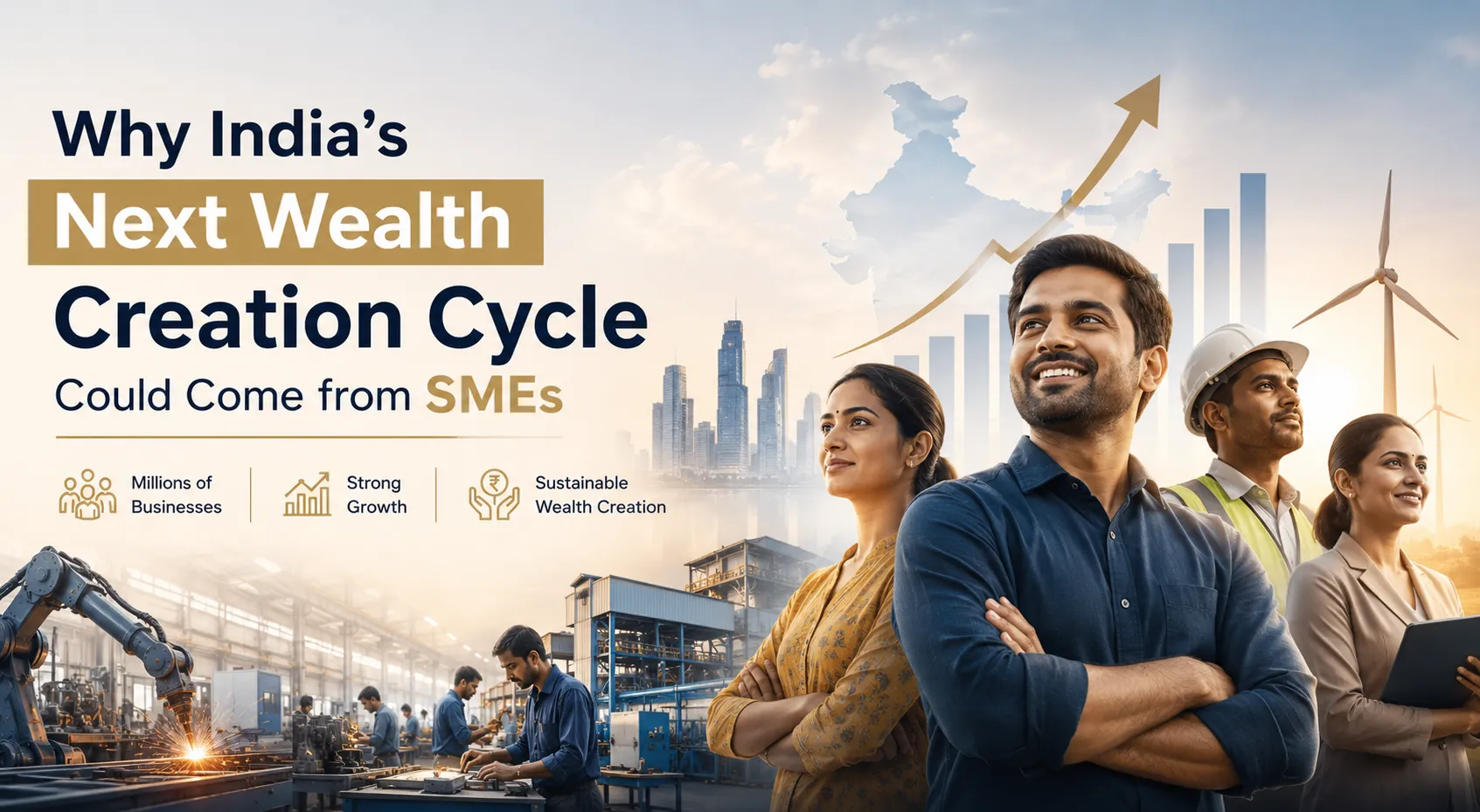
Why India’s Next Wealth Creation Cycle Could Come from SMEs

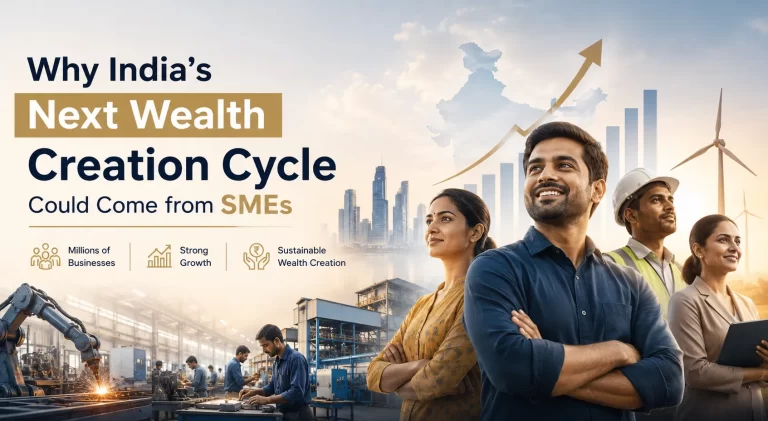
India’s next major wealth creation cycle could come from small and medium enterprises (SMEs) because the country is undergoing structural changes that favour scalable, founder-led, capital-efficient businesses. Formalisation, digital adoption, manufacturing growth, improved access to capital and integration into global supply chains are creating a stronger environment for select SMEs to grow over time.
For long-term investors, the opportunity is not to buy every SME, but to identify businesses with strong governance, scalable models and durable competitive advantages.

Why Are SMEs Becoming Important in India's Wealth Creation Story?

For decades, wealth creation in India’s equity markets has often been associated with businesses that eventually became household names. Investors who identified these companies early were able to participate in years of compounding as the businesses expanded, formalised and scaled.

Today, India appears to be entering another structural phase of economic development. Unlike earlier cycles led primarily by large corporations, the next decade could see a meaningful contribution from a new generation of small and medium enterprises (SMEs).

This is not just a market observation. It reflects long-term changes across India’s economy, capital markets and business environment.

1. India Is Building an Economy That Favors Emerging Businesses

India’s growth story is no longer driven by consumption alone.

Manufacturing expansion, digital infrastructure, supply chain diversification, formalisation of businesses, infrastructure spending and financial inclusion are creating an ecosystem where smaller businesses can scale faster than they could a decade ago.

Many businesses that once operated only in regional markets are now serving customers nationwide through:

  • Technology platforms
  • Organised distribution networks
  • Better logistics
  • Improved access to capital
  • Digital payments and compliance systems

As barriers to scaling reduce, the opportunity set for investors naturally expands.

“While it’s tempting to pull back, we believe that companies that double down on growth will not only rebound faster but will also emerge stronger as a result. “

2. Formalisation Is Improving the Quality of SMEs

One of the most important transformations in India’s SME ecosystem has been the shift toward formalisation.

The implementation of GST, increasing digital adoption, UPI-led payment infrastructure, improved tax compliance, mandatory audits, stronger governance standards and easier access to institutional financing have collectively created businesses that are more transparent than in previous decades.

Why does this matter for investors?

Businesses with:

  • Cleaner financial reporting
  • Stronger governance practices
  • Better compliance systems
  • Greater operational visibility

are easier to evaluate from a long-term investment perspective.

Rather than simply increasing the number of SMEs, India is gradually improving the overall quality of its SME base.

3. Access to Capital Is Becoming a Competitive Advantage

Historically, one of the biggest constraints for growing Indian businesses was limited access to growth capital.

That environment is changing.

Today, SMEs can access capital through multiple channels, including:

  • Dedicated SME exchanges
  • Private capital
  • Venture funding
  • Private equity participation
  • Institutional investors
  • Specialised investment funds
  • Debt and working capital solutions

This capital can help businesses:

  • Expand manufacturing capacity
  • Invest in technology
  • Enter new markets
  • Improve governance
  • Professionalise management
  • Build stronger brands

When capital is combined with disciplined execution, it can accelerate growth far beyond what internal cash generation alone could achieve.

4. India's SMEs Are Becoming Part of Global Supply Chains

Global manufacturing is undergoing structural diversification.

As companies seek to reduce concentration risk and build more resilient supply chains, India continues to strengthen its position across sectors such as:

  • Engineering
  • Speciality chemicals
  • Precision manufacturing
  • Electronics
  • Industrial components
  • Pharmaceuticals
  • Defence
  • Renewable energy
  • Industrial automation

Many listed SMEs are not consumer-facing brands. Instead, they operate as specialised suppliers within larger domestic and global value chains.

These businesses may receive limited public attention, but their revenues often benefit from long-term structural trends rather than short-term consumer demand.

5. Wealth Creation Often Begins Before Recognition

Financial markets frequently reward businesses long before they become widely recognised.

Many of today’s large-cap companies were once relatively unknown businesses operating within niche industries. Their strongest period of wealth creation often occurred during the years when revenues, profits and market share were compounding—but before institutional ownership became widespread.

This highlights an important principle of long-term investing:

The objective is rarely to identify businesses that are already popular.
It is to identify businesses whose fundamentals can earn broader market recognition over time.

For investors, this is where SMEs can become especially interesting.

6. Why SME Investing Requires Selectivity

Not every SME becomes a successful long-term business.

Some remain small.
Some struggle with governance.
Others face industry-specific challenges or capital allocation issues.

This is why investing in SMEs requires greater discipline than investing in mature companies.

Key factors to evaluate before investing in SMEs

  • Management quality
  • Promoter integrity and governance standards
  • Balance sheet strength
  • Scalability of the business model
  • Competitive positioning
  • Capital efficiency
  • Industry tailwinds
  • Earnings visibility
  • Liquidity and valuation

The opportunity within SMEs is broad, but meaningful wealth creation is likely to emerge from careful selection rather than broad exposure.

7. Looking Beyond Market Capitalisation

Market capitalisation often reflects where a business stands today.

Long-term investing focuses on where that business could be several years from now.

India’s entrepreneurial ecosystem continues to produce businesses solving specialised problems across:

  • Manufacturing
  • Industrial technology
  • Healthcare
  • Infrastructure
  • Financial services
  • Software
  • Consumer products
  • Export-oriented industries

Many of these companies remain relatively small in market value, yet operate in industries benefiting from structural economic growth.

For patient investors, the gap between current size and future potential can become an important source of long-term value creation

Why Is the SME Opportunity Structural, Not Cyclical?

India’s SME sector is benefiting from multiple long-term tailwinds:

  • A growing domestic economy
  • Rising manufacturing activity
  • Digital transformation
  • Expanding formalisation
  • Better financing options
  • Strong entrepreneurial culture
  • Increasing participation from capital markets

These are not short-term market events. They represent structural shifts in the way Indian businesses are created, funded and scaled.

As a result, SMEs are becoming increasingly important contributors to India’s future economic growth.

Key MSME Statistics in India

Metric Latest Estimate
Contribution to India's GDP ~30%
Share of Manufacturing Output ~35%
Share of Exports ~46%
Employment Supported 20+ crore people

These figures show that SMEs are not a peripheral part of the economy. They are central to India's long-term growth trajectory.

Frequently Asked Questions

SMEs can offer higher growth potential because they operate from a smaller base, are often founder-led and may benefit from expanding industries. Successful businesses can also experience valuation re-rating as institutional participation increases.

Generally, yes. SMEs may have lower liquidity, shorter operating histories and greater earnings volatility. That is why governance, financial strength, management quality and industry positioning are especially important.

Formalisation improves transparency, compliance, access to credit and investor confidence. It also helps businesses build stronger systems and become more scalable over time.

Yes. Many of today’s established listed companies began as small businesses. While not every SME becomes a large company, businesses with strong management, sound governance and scalable models can create substantial long-term value.

Because India is creating an environment where smaller businesses can scale faster than before. Structural reforms, capital access and supply chain integration are improving the odds that select SMEs can grow into future market leaders.

Final Thoughts

India’s next generation of market leaders may not necessarily come from businesses that are already well known.

Many are likely to be companies that are quietly strengthening governance, expanding capacity, building specialised capabilities and steadily increasing their market presence.

For investors, understanding these structural trends is often more valuable than predicting short-term market movements.

As India’s economy continues to evolve, high-quality SMEs could play an increasingly significant role in the country’s next wealth creation cycle.

References

  1. Government of India, Ministry of MSME – Contribution of MSMEs to GDP, Exports and Employment (July 2024).
  2. Economic Survey 2025–26, Ministry of Finance – MSMEs as the backbone of India’s industrial economy.
  3. Directorate General of Commercial Intelligence & Statistics (DGCIS), MSME export statistics (referenced by PIB).
  4. Udyam Registration Portal employment statistics, Ministry of MSME (referenced by PIB).
Tags:

What do you think?

Leave a Reply

Your email address will not be published. Required fields are marked *

Why India’s Next Wealth Creation Cycle Could Come from SMEs

India’s next major wealth creation cycle could come from small and medium enterprises (SMEs) because the country is undergoing structural changes that favour scalable, founder-led, capital-efficient businesses. Formalisation, digital adoption, manufacturing growth, improved access to capital and integration into global supply chains are creating a stronger environment for select SMEs to grow over time.
For long-term investors, the opportunity is not to buy every SME, but to identify businesses with strong governance, scalable models and durable competitive advantages.

Why Are SMEs Becoming Important in India's Wealth Creation Story?

For decades, wealth creation in India’s equity markets has often been associated with businesses that eventually became household names. Investors who identified these companies early were able to participate in years of compounding as the businesses expanded, formalised and scaled.

Today, India appears to be entering another structural phase of economic development. Unlike earlier cycles led primarily by large corporations, the next decade could see a meaningful contribution from a new generation of small and medium enterprises (SMEs).

This is not just a market observation. It reflects long-term changes across India’s economy, capital markets and business environment.

1. India Is Building an Economy That Favors Emerging Businesses

India’s growth story is no longer driven by consumption alone.

Manufacturing expansion, digital infrastructure, supply chain diversification, formalisation of businesses, infrastructure spending and financial inclusion are creating an ecosystem where smaller businesses can scale faster than they could a decade ago.

Many businesses that once operated only in regional markets are now serving customers nationwide through:

  • Technology platforms
  • Organised distribution networks
  • Better logistics
  • Improved access to capital
  • Digital payments and compliance systems

As barriers to scaling reduce, the opportunity set for investors naturally expands.

“While it’s tempting to pull back, we believe that companies that double down on growth will not only rebound faster but will also emerge stronger as a result. “

2. Formalisation Is Improving the Quality of SMEs

One of the most important transformations in India’s SME ecosystem has been the shift toward formalisation.

The implementation of GST, increasing digital adoption, UPI-led payment infrastructure, improved tax compliance, mandatory audits, stronger governance standards and easier access to institutional financing have collectively created businesses that are more transparent than in previous decades.

Why does this matter for investors?

Businesses with:

  • Cleaner financial reporting
  • Stronger governance practices
  • Better compliance systems
  • Greater operational visibility

are easier to evaluate from a long-term investment perspective.

Rather than simply increasing the number of SMEs, India is gradually improving the overall quality of its SME base.

3. Access to Capital Is Becoming a Competitive Advantage

Historically, one of the biggest constraints for growing Indian businesses was limited access to growth capital.

That environment is changing.

Today, SMEs can access capital through multiple channels, including:

  • Dedicated SME exchanges
  • Private capital
  • Venture funding
  • Private equity participation
  • Institutional investors
  • Specialised investment funds
  • Debt and working capital solutions

This capital can help businesses:

  • Expand manufacturing capacity
  • Invest in technology
  • Enter new markets
  • Improve governance
  • Professionalise management
  • Build stronger brands

When capital is combined with disciplined execution, it can accelerate growth far beyond what internal cash generation alone could achieve.

4. India's SMEs Are Becoming Part of Global Supply Chains

Global manufacturing is undergoing structural diversification.

As companies seek to reduce concentration risk and build more resilient supply chains, India continues to strengthen its position across sectors such as:

  • Engineering
  • Speciality chemicals
  • Precision manufacturing
  • Electronics
  • Industrial components
  • Pharmaceuticals
  • Defence
  • Renewable energy
  • Industrial automation

Many listed SMEs are not consumer-facing brands. Instead, they operate as specialised suppliers within larger domestic and global value chains.

These businesses may receive limited public attention, but their revenues often benefit from long-term structural trends rather than short-term consumer demand.

5. Wealth Creation Often Begins Before Recognition

Financial markets frequently reward businesses long before they become widely recognised.

Many of today’s large-cap companies were once relatively unknown businesses operating within niche industries. Their strongest period of wealth creation often occurred during the years when revenues, profits and market share were compounding—but before institutional ownership became widespread.

This highlights an important principle of long-term investing:

The objective is rarely to identify businesses that are already popular.
It is to identify businesses whose fundamentals can earn broader market recognition over time.

For investors, this is where SMEs can become especially interesting.

6. Why SME Investing Requires Selectivity

Not every SME becomes a successful long-term business.

Some remain small.
Some struggle with governance.
Others face industry-specific challenges or capital allocation issues.

This is why investing in SMEs requires greater discipline than investing in mature companies.

Key factors to evaluate before investing in SMEs

  • Management quality
  • Promoter integrity and governance standards
  • Balance sheet strength
  • Scalability of the business model
  • Competitive positioning
  • Capital efficiency
  • Industry tailwinds
  • Earnings visibility
  • Liquidity and valuation

The opportunity within SMEs is broad, but meaningful wealth creation is likely to emerge from careful selection rather than broad exposure.

7. Looking Beyond Market Capitalisation

Market capitalisation often reflects where a business stands today.

Long-term investing focuses on where that business could be several years from now.

India’s entrepreneurial ecosystem continues to produce businesses solving specialised problems across:

  • Manufacturing
  • Industrial technology
  • Healthcare
  • Infrastructure
  • Financial services
  • Software
  • Consumer products
  • Export-oriented industries

Many of these companies remain relatively small in market value, yet operate in industries benefiting from structural economic growth.

For patient investors, the gap between current size and future potential can become an important source of long-term value creation

Why Is the SME Opportunity Structural, Not Cyclical?

India’s SME sector is benefiting from multiple long-term tailwinds:

  • A growing domestic economy
  • Rising manufacturing activity
  • Digital transformation
  • Expanding formalisation
  • Better financing options
  • Strong entrepreneurial culture
  • Increasing participation from capital markets

These are not short-term market events. They represent structural shifts in the way Indian businesses are created, funded and scaled.

As a result, SMEs are becoming increasingly important contributors to India’s future economic growth.

Key MSME Statistics in India

Metric Latest Estimate
Contribution to India's GDP ~30%
Share of Manufacturing Output ~35%
Share of Exports ~46%
Employment Supported 20+ crore people

These figures show that SMEs are not a peripheral part of the economy. They are central to India's long-term growth trajectory.

Frequently Asked Questions

SMEs can offer higher growth potential because they operate from a smaller base, are often founder-led and may benefit from expanding industries. Successful businesses can also experience valuation re-rating as institutional participation increases.

Generally, yes. SMEs may have lower liquidity, shorter operating histories and greater earnings volatility. That is why governance, financial strength, management quality and industry positioning are especially important.

Formalisation improves transparency, compliance, access to credit and investor confidence. It also helps businesses build stronger systems and become more scalable over time.

Yes. Many of today’s established listed companies began as small businesses. While not every SME becomes a large company, businesses with strong management, sound governance and scalable models can create substantial long-term value.

Because India is creating an environment where smaller businesses can scale faster than before. Structural reforms, capital access and supply chain integration are improving the odds that select SMEs can grow into future market leaders.

Final Thoughts

India’s next generation of market leaders may not necessarily come from businesses that are already well known.

Many are likely to be companies that are quietly strengthening governance, expanding capacity, building specialised capabilities and steadily increasing their market presence.

For investors, understanding these structural trends is often more valuable than predicting short-term market movements.

As India’s economy continues to evolve, high-quality SMEs could play an increasingly significant role in the country’s next wealth creation cycle.

References

  1. Government of India, Ministry of MSME – Contribution of MSMEs to GDP, Exports and Employment (July 2024).
  2. Economic Survey 2025–26, Ministry of Finance – MSMEs as the backbone of India’s industrial economy.
  3. Directorate General of Commercial Intelligence & Statistics (DGCIS), MSME export statistics (referenced by PIB).
  4. Udyam Registration Portal employment statistics, Ministry of MSME (referenced by PIB).
14%
portion of total synergy savings derived from IT consolidation

Why India’s Next Wealth Creation Cycle Could Come from SMEs

Why India’s Next Wealth Creation Cycle Could Come from SMEs-bn

India’s next major wealth creation cycle could come from small and medium enterprises (SMEs) because the country is undergoing structural changes that favour scalable, founder-led, capital-efficient businesses. Formalisation, digital adoption, manufacturing growth, improved access to capital and integration into global supply chains are creating a stronger environment for select SMEs to grow over time.
For long-term investors, the opportunity is not to buy every SME, but to identify businesses with strong governance, scalable models and durable competitive advantages.

Why Are SMEs Becoming Important in India's Wealth Creation Story?

For decades, wealth creation in India’s equity markets has often been associated with businesses that eventually became household names. Investors who identified these companies early were able to participate in years of compounding as the businesses expanded, formalised and scaled.

Today, India appears to be entering another structural phase of economic development. Unlike earlier cycles led primarily by large corporations, the next decade could see a meaningful contribution from a new generation of small and medium enterprises (SMEs).

This is not just a market observation. It reflects long-term changes across India’s economy, capital markets and business environment.

1. India Is Building an Economy That Favors Emerging Businesses

India’s growth story is no longer driven by consumption alone.

Manufacturing expansion, digital infrastructure, supply chain diversification, formalisation of businesses, infrastructure spending and financial inclusion are creating an ecosystem where smaller businesses can scale faster than they could a decade ago.

Many businesses that once operated only in regional markets are now serving customers nationwide through:

  • Technology platforms
  • Organised distribution networks
  • Better logistics
  • Improved access to capital
  • Digital payments and compliance systems

As barriers to scaling reduce, the opportunity set for investors naturally expands.

“While it’s tempting to pull back, we believe that companies that double down on growth will not only rebound faster but will also emerge stronger as a result. “

2. Formalisation Is Improving the Quality of SMEs

One of the most important transformations in India’s SME ecosystem has been the shift toward formalisation.

The implementation of GST, increasing digital adoption, UPI-led payment infrastructure, improved tax compliance, mandatory audits, stronger governance standards and easier access to institutional financing have collectively created businesses that are more transparent than in previous decades.

Why does this matter for investors?

Businesses with:

  • Cleaner financial reporting
  • Stronger governance practices
  • Better compliance systems
  • Greater operational visibility

are easier to evaluate from a long-term investment perspective.

Rather than simply increasing the number of SMEs, India is gradually improving the overall quality of its SME base.

3. Access to Capital Is Becoming a Competitive Advantage

Historically, one of the biggest constraints for growing Indian businesses was limited access to growth capital.

That environment is changing.

Today, SMEs can access capital through multiple channels, including:

  • Dedicated SME exchanges
  • Private capital
  • Venture funding
  • Private equity participation
  • Institutional investors
  • Specialised investment funds
  • Debt and working capital solutions

This capital can help businesses:

  • Expand manufacturing capacity
  • Invest in technology
  • Enter new markets
  • Improve governance
  • Professionalise management
  • Build stronger brands

When capital is combined with disciplined execution, it can accelerate growth far beyond what internal cash generation alone could achieve.

4. India's SMEs Are Becoming Part of Global Supply Chains

Global manufacturing is undergoing structural diversification.

As companies seek to reduce concentration risk and build more resilient supply chains, India continues to strengthen its position across sectors such as:

  • Engineering
  • Speciality chemicals
  • Precision manufacturing
  • Electronics
  • Industrial components
  • Pharmaceuticals
  • Defence
  • Renewable energy
  • Industrial automation

Many listed SMEs are not consumer-facing brands. Instead, they operate as specialised suppliers within larger domestic and global value chains.

These businesses may receive limited public attention, but their revenues often benefit from long-term structural trends rather than short-term consumer demand.

5. Wealth Creation Often Begins Before Recognition

Financial markets frequently reward businesses long before they become widely recognised.

Many of today’s large-cap companies were once relatively unknown businesses operating within niche industries. Their strongest period of wealth creation often occurred during the years when revenues, profits and market share were compounding—but before institutional ownership became widespread.

This highlights an important principle of long-term investing:

The objective is rarely to identify businesses that are already popular.
It is to identify businesses whose fundamentals can earn broader market recognition over time.

For investors, this is where SMEs can become especially interesting.

6. Why SME Investing Requires Selectivity

Not every SME becomes a successful long-term business.

Some remain small.
Some struggle with governance.
Others face industry-specific challenges or capital allocation issues.

This is why investing in SMEs requires greater discipline than investing in mature companies.

Key factors to evaluate before investing in SMEs

  • Management quality
  • Promoter integrity and governance standards
  • Balance sheet strength
  • Scalability of the business model
  • Competitive positioning
  • Capital efficiency
  • Industry tailwinds
  • Earnings visibility
  • Liquidity and valuation

The opportunity within SMEs is broad, but meaningful wealth creation is likely to emerge from careful selection rather than broad exposure.

7. Looking Beyond Market Capitalisation

Market capitalisation often reflects where a business stands today.

Long-term investing focuses on where that business could be several years from now.

India’s entrepreneurial ecosystem continues to produce businesses solving specialised problems across:

  • Manufacturing
  • Industrial technology
  • Healthcare
  • Infrastructure
  • Financial services
  • Software
  • Consumer products
  • Export-oriented industries

Many of these companies remain relatively small in market value, yet operate in industries benefiting from structural economic growth.

For patient investors, the gap between current size and future potential can become an important source of long-term value creation

Why Is the SME Opportunity Structural, Not Cyclical?

India’s SME sector is benefiting from multiple long-term tailwinds:

  • A growing domestic economy
  • Rising manufacturing activity
  • Digital transformation
  • Expanding formalisation
  • Better financing options
  • Strong entrepreneurial culture
  • Increasing participation from capital markets

These are not short-term market events. They represent structural shifts in the way Indian businesses are created, funded and scaled.

As a result, SMEs are becoming increasingly important contributors to India’s future economic growth.

Key MSME Statistics in India

Metric Latest Estimate
Contribution to India's GDP ~30%
Share of Manufacturing Output ~35%
Share of Exports ~46%
Employment Supported 20+ crore people

These figures show that SMEs are not a peripheral part of the economy. They are central to India's long-term growth trajectory.

Frequently Asked Questions

SMEs can offer higher growth potential because they operate from a smaller base, are often founder-led and may benefit from expanding industries. Successful businesses can also experience valuation re-rating as institutional participation increases.

Generally, yes. SMEs may have lower liquidity, shorter operating histories and greater earnings volatility. That is why governance, financial strength, management quality and industry positioning are especially important.

Formalisation improves transparency, compliance, access to credit and investor confidence. It also helps businesses build stronger systems and become more scalable over time.

Yes. Many of today’s established listed companies began as small businesses. While not every SME becomes a large company, businesses with strong management, sound governance and scalable models can create substantial long-term value.

Because India is creating an environment where smaller businesses can scale faster than before. Structural reforms, capital access and supply chain integration are improving the odds that select SMEs can grow into future market leaders.

Final Thoughts

India’s next generation of market leaders may not necessarily come from businesses that are already well known.

Many are likely to be companies that are quietly strengthening governance, expanding capacity, building specialised capabilities and steadily increasing their market presence.

For investors, understanding these structural trends is often more valuable than predicting short-term market movements.

As India’s economy continues to evolve, high-quality SMEs could play an increasingly significant role in the country’s next wealth creation cycle.

References

  1. Government of India, Ministry of MSME – Contribution of MSMEs to GDP, Exports and Employment (July 2024).
  2. Economic Survey 2025–26, Ministry of Finance – MSMEs as the backbone of India’s industrial economy.
  3. Directorate General of Commercial Intelligence & Statistics (DGCIS), MSME export statistics (referenced by PIB).
  4. Udyam Registration Portal employment statistics, Ministry of MSME (referenced by PIB).
14%
portion of total synergy savings derived from IT consolidation